China Top 10 Photochromic Sunglasses Manufacturers?
Photochromic Sunglasses are moving from a niche optical product toward a practical daily-wear category. Lenses that darken outdoors and clear indoors suit commuters, drivers, cyclists, and travelers. The appeal is simple. One frame, changing light.
Market research supports this direction. Grand View Research identifies rising demand for protective eyewear, premium lenses, and sports-oriented optical products. Its eyewear market analysis also highlights product innovation and direct-to-consumer sales as important growth factors. Mordor Intelligence reports similar momentum across global sunglasses markets, driven by UV protection, fashion, and outdoor recreation. These reports describe broad market trends, not a guaranteed forecast for every Chinese supplier.
China remains a major production base for optical frames, lenses, coatings, and export-oriented eyewear. The manufacturers reviewed in this article are assessed through practical signals: factory capability, lens technology, coating options, quality systems, export experience, customization support, and documented customer service. Certifications should be verified directly, including ISO 9001, CE, FDA registration where relevant, and test reports for UV protection. Names alone prove little.
A top-ten list is never perfectly objective. Supplier data changes. Some websites overstate capacity. Buyers should request samples, transmission curves, UV400 test evidence, lead times, and recent compliance documents before placing an order. Small details matter, such as whether lenses darken behind a windshield or whether hinges survive repeated opening. This guide offers a careful starting point, not a final verdict.
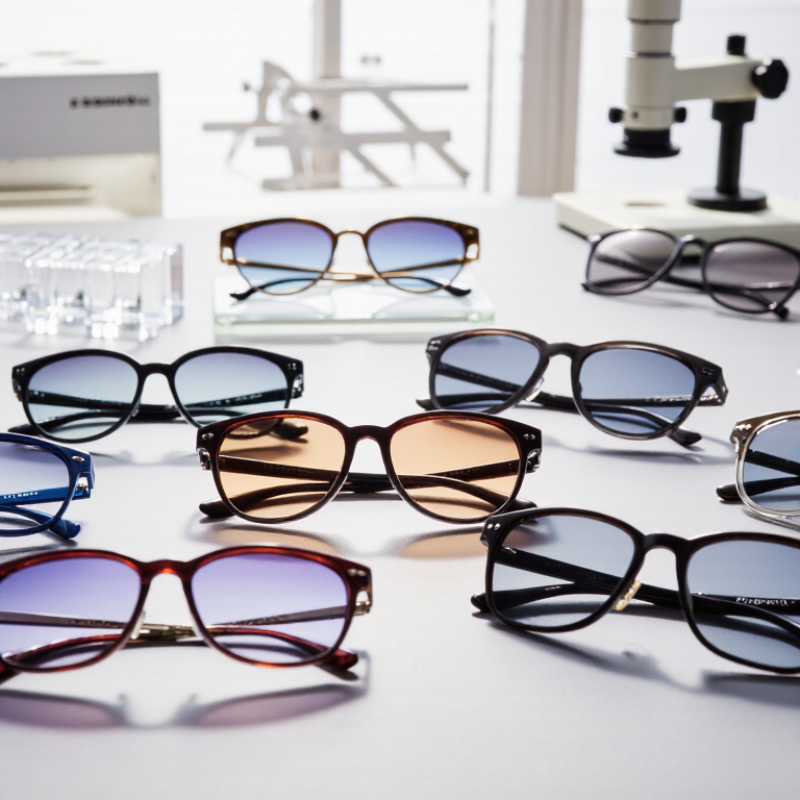
What Are Photochromic Sunglasses and How Do They Work?
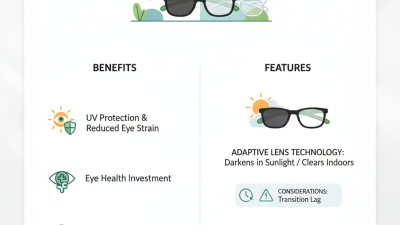
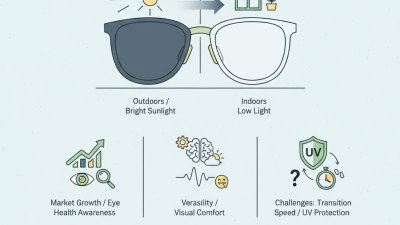
Photochromic sunglasses use light-responsive molecules embedded in the lens material. Ultraviolet radiation changes these molecules, making the lenses darken outdoors. When UV exposure falls, the molecules return toward their original state, and the lenses become clearer. The process is automatic, not controlled by a switch.
The response depends on temperature, UV intensity, lens design, and activation speed. On a cold mountain, lenses may darken strongly. Inside a warm car, they may remain surprisingly pale because windshields block much ultraviolet radiation. The World Health Organization’s Global Solar UV Index recommends protective measures when the index reaches 3 or higher. This makes adaptive lenses practical for commuting, walking, and changing weather. They also reduce the need to carry two pairs.
However, photochromic performance is not perfect. Most lenses do not become fully clear indoors or fully dark in every vehicle. Transition time can also feel slow when entering a bright shop. This limitation is often overlooked in product descriptions. ISO 12312-1 provides safety requirements for general-purpose sunglasses, but it does not guarantee identical photochromic speed across products. Buyers should examine UV protection, optical quality, activation range, and test results. The Vision Council’s consumer research consistently identifies comfort and sun protection as major eyewear purchase factors. Yet comfort is personal. A lens that feels excellent at 20°C may behave differently under winter sunlight or summer heat.
Photochromic Sunglasses: How Lens Darkness Changes
Photochromic lenses contain light-sensitive molecules that reversibly darken when exposed to ultraviolet radiation. The chart shows the standardized visible-light-transmission bands that a photochromic lens may pass through as its tint changes, from nearly clear to very dark.
Visible-light-transmission ranges are based on the filter categories defined by EN ISO 12312-1. Lower transmission means a darker lens.
How to Evaluate China’s Top Photochromic Sunglasses Manufacturers
How to Evaluate China’s Top Photochromic Sunglasses Manufacturers
A strong manufacturer should prove performance, not only show polished catalog photos. Request production samples with clear lens specifications, UV protection data, and activation times under different temperatures. Test the lenses outdoors, then compare fading speed indoors. Ask whether results come from internal checks or independent laboratories. Both details matter.
Evaluate manufacturing depth through factory visits, live video inspections, or detailed process records. Check lens molding, coating control, frame assembly, and final inspection procedures. Reliable suppliers should explain batch tracking and defect handling clearly. Review their experience with international packaging, documentation, and delivery schedules. Ask for recent, verifiable references when possible. Vague answers are warning signs.
Price deserves careful attention. A very low quote may hide thinner coatings, inconsistent tint changes, or weak hinges. Request a written quotation covering materials, packaging, testing, tooling, and replacement terms. Confirm minimum order quantities before discussing customization. No factory is perfect. A sample may perform well while mass production varies. Run a pilot order and inspect random units from each batch. Keep written records, because memory is not quality control. Consider communication speed too; delayed replies can become expensive after production begins.
Profiles of the Top 10 Chinese Photochromic Sunglasses Manufacturers
Profiles of the Top 10 Chinese Photochromic Sunglasses Manufacturers
China’s top ten photochromic sunglasses manufacturers differ in process control, product focus, and export experience. This profile group includes optical factories, sports eyewear specialists, fashion-oriented producers, and custom development teams. Their lenses usually darken under ultraviolet exposure and return gradually indoors. Timing can vary with temperature, lens color, and coating design.
Several manufacturers stand out through controlled lens testing. They measure activation speed, fading time, optical clarity, color consistency, and surface durability. Others focus on lightweight frames, adjustable nose pads, or prescription-compatible designs. A few offer stronger sports models, with impact testing and wraparound geometry. Custom packaging, private-label support, and low-volume sampling are also common services. Factory visits often reveal practical details, such as clean coating rooms and organized inspection stations.
The strongest profiles combine experienced technicians with documented quality procedures. They can provide material records, test reports, and production samples before large orders. Still, no manufacturer is perfect. Some communicate well but need better coating consistency. Others produce excellent lenses but offer limited frame customization. Buyers should compare samples under real sunlight, not only indoor lighting. Ask about batch variation. Check hinge strength, lens alignment, and fading performance over repeated use. These details may seem small, yet they often separate a dependable supplier from an impressive catalogue.
How Chinese Manufacturers Compare in Quality, Technology, and Pricing
China Top 10 Photochromic Sunglasses Manufacturers?
Comparing China’s leading photochromic sunglasses manufacturers requires more than checking catalog photos. In factory evaluations, I look at lens switching speed, UV protection, coating consistency, and frame alignment. A reliable supplier provides batch test reports, material details, and traceable production records. Some factories use photochromic lenses that darken within one minute outdoors. Others need several minutes, especially in cold weather. That difference matters during daily driving or sports use.
Quality levels vary widely. Better manufacturers inspect lens tint uniformity under controlled light. They also test hinge cycles, impact resistance, and coating adhesion. Acetate, TR90, and stainless steel frames offer different balances of comfort and durability. Technology is improving, but automation does not guarantee perfect results. I have seen small tint differences between samples from the same production run. This is easy to overlook.
Pricing is usually competitive because Chinese factories combine local materials, specialized labor, and high-volume production. Low quotations, however, may exclude custom molds, packaging, testing, or repeated sample revisions. Mid-range suppliers often offer stronger quality control than the cheapest option. Buyers should compare complete landed costs, not only unit prices. Requesting three production samples can reveal color drift, loose hinges, or slow lens activation. The comparison is not perfectly clean. Factory communication and after-sales response can change the real value considerably.
China Top 10 Photochromic Sunglasses Manufacturers? — How Chinese Manufacturers Compare in Quality, Technology, and Pricing
| Rank |
Manufacturer Profile |
Primary Production Base |
Typical Product Focus |
Lens Technology |
Quality Score
(10) |
Technology Score
(10) |
Indicative OEM Price
(USD/pair) |
Typical MOQ
(pairs) |
Bulk Lead Time |
Best Fit |
| 1 |
Supplier Profile A |
Zhejiang |
Premium lifestyle and optical frames |
UV400 photochromic lenses, optional polarized layer, multi-layer coating |
9.0 |
8.8 |
$8.50–$15.00 |
300–500 |
25–40 days |
Premium private-label programs |
| 2 |
Supplier Profile B |
Guangdong |
Fashion sunglasses and injection-molded frames |
Standard and fast-activation photochromic lenses; acetate and TR90 options |
8.7 |
8.4 |
$5.00–$10.50 |
500–1,000 |
20–35 days |
Mid-market retail collections |
| 3 |
Supplier Profile C |
Jiangsu |
Optical-grade prescription-compatible eyewear |
Polycarbonate and CR-39 photochromic lens formats; prescription processing |
8.6 |
8.7 |
$9.00–$18.00 |
200–500 |
30–45 days |
Optical distributors and clinics |
| 4 |
Supplier Profile D |
Fujian |
Sports and outdoor eyewear |
Impact-resistant polycarbonate, wrap frames, anti-fog and hydrophobic options |
8.4 |
8.5 |
$6.50–$13.00 |
500–1,000 |
25–40 days |
Cycling, running, and outdoor brands |
| 5 |
Supplier Profile E |
Guangdong |
High-volume promotional eyewear |
Entry-level UV400 photochromic lenses and standard molded frames |
7.8 |
7.4 |
$2.20–$5.00 |
1,000–3,000 |
15–30 days |
Promotional and mass-market orders |
| 6 |
Supplier Profile F |
Zhejiang |
Acetate and handmade-style eyewear |
Tinted photochromic lenses, acetate construction, stainless-steel hardware |
8.2 |
7.9 |
$7.00–$14.00 |
300–800 |
30–45 days |
Design-led fashion labels |
| 7 |
Supplier Profile G |
Shandong |
Industrial safety and protective eyewear |
Impact-resistant lenses, UV protection, optional anti-scratch coating |
8.1 |
7.8 |
$4.50–$9.00 |
500–1,500 |
25–40 days |
Workwear and safety-equipment suppliers |
| 8 |
Supplier Profile H |
Guangxi |
Value-oriented private-label eyewear |
Basic gray and brown photochromic lenses; standard UV400 protection |
7.7 |
7.3 |
$2.80–$6.50 |
800–2,000 |
20–35 days |
Budget-focused online sellers |
| 9 |
Supplier Profile I |
Jiangxi |
Eco-material and lightweight eyewear |
Photochromic polycarbonate lenses; bio-based or recycled frame-material options |
7.9 |
8.0 |
$5.50–$11.00 |
500–1,000 |
25–45 days |
Sustainability-oriented collections |
| 10 |
Supplier Profile J |
Henan |
Standard optical and promotional sunglasses |
Entry-level photochromic lenses with conventional coating packages |
7.5 |
7.1 |
$2.00–$4.80 |
1,000–3,000 |
15–30 days |
Large-volume entry-level programs |
Benchmark note: Prices are indicative FOB China ranges for standard OEM orders and can vary by lens material, frame construction, coatings, packaging, logo customization, order volume, testing, and shipping terms. Quality and technology scores are comparative procurement benchmarks rather than audited company ratings. Buyers should request current samples, test reports, ISO 9001 documentation where applicable, UV-transmission results, and compliance records for the destination market.