Computer Eyeglasses are becoming a practical category for people who spend long hours switching between laptops, tablets, and phones. The opportunity is real, but the numbers need careful reading. Grand View Research valued the global eyewear market at approximately USD 183.36 billion in 2023 and projected continued growth through 2030. That figure covers eyewear broadly; it is not a market-size estimate for Computer Eyeglasses alone. The World Health Organization also reports that at least 2.2 billion people worldwide have near or distance vision impairment. These figures explain the wider need for vision products, not a guaranteed demand for any single lens type.
For global buyers, choosing among China’s Computer Eyeglasses manufacturers means looking beyond polished product photos. Ask for lens specifications, sample consistency, coating details, production capacity, and clear quality-control records. Check how suppliers handle prescription options and fit, too. Small differences matter. A frame may look sturdy on a screen but feel uncomfortable after a full workday. Optometrist Gary Heiting, OD, describes computer glasses as “prescription glasses that are designed to wear when doing computer work.” This is a useful definition, not proof that every wearer needs them or that one lens suits everyone. Buyers should verify technical claims and request documentation before placing an order. This guide will compare manufacturers through product range, customization, communication, and quality assurance. It will also note where public information is limited, because supplier research is never perfectly tidy.
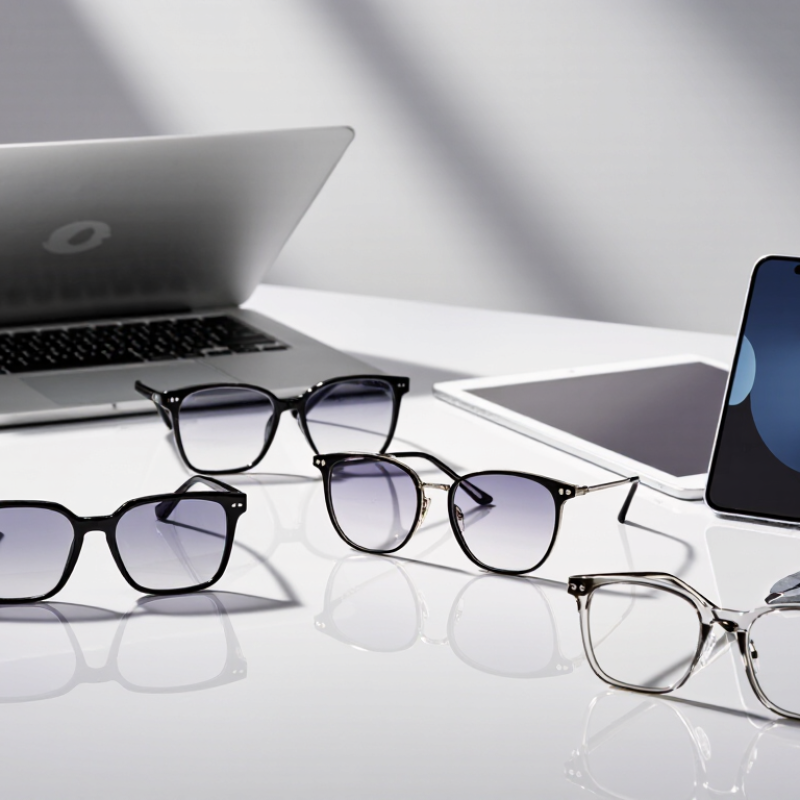
Computer eyeglasses use lenses chosen for the distance between your eyes and a screen, often around 50–70 centimetres. They may correct a prescription, ease focusing at that distance, or reduce reflections with an anti-reflective coating. The right lens depends on the wearer’s vision and working setup. Small details matter.
Some lenses also filter blue-violet light, but that feature is not a proven cure for screen discomfort. A 2023 Cochrane review examined 17 randomized trials involving 619 adults. It found that blue-light-filtering lenses may make little or no difference to short-term visual fatigue. That evidence deserves attention.
Screen-related discomfort can also come from long periods of near focus, glare, dry air, or fewer complete blinks. The Vision Council’s 2016 digital eye strain report found that 65% of surveyed U.S. adults reported symptoms. Glasses cannot fix every cause. Adjust screen brightness, reduce reflections, and take regular distance-viewing breaks; an eye-care professional can assess persistent blur or headaches. I may be missing one practical factor: people often keep the monitor too close.
China’s computer-eyewear manufacturing landscape includes component sourcing, lens processing, frame production, and final assembly. Many suppliers coordinate specialist workshops, while others handle more stages in-house. That distinction matters: a low quotation may exclude coatings, packaging, or repeated quality checks.
Small details reveal workmanship. Hinges should open smoothly, lens edges should sit evenly, and nose pads should stay secure during handling. This is not glamorous work. Buyers can compare sample pairs for fit, finish, optical clarity, and consistency before discussing larger orders. Ask how the factory checks lens specifications and tracks defects; clear records are more useful than broad promises.
Production still has weak spots. A polished sample does not guarantee every batch will match it, and even a detailed checklist can miss changes on the line. Confirm material options, order minimums, lead times, and packaging requirements in writing. If computer-use lenses include filtering claims, request test documentation and review what the results actually measure. A second sample after adjustments can catch issues such as uneven tint or a frame that feels tight after several minutes of wear.
| Manufacturing Dimension | Common Options and Industry Practices | Checks for Global Buyers |
|---|---|---|
| Product formats | Plano computer eyewear and prescription spectacles with lenses intended for screen use. | Confirm whether the supplier supports plano lenses, prescription processing, or both. |
| Lens materials | Common options include CR-39 (about 1.50 refractive index), polycarbonate (about 1.59), Trivex (about 1.53), and high-index materials such as 1.60 or 1.67. | Compare optical clarity, impact needs, lens thickness, prescription range, and material documentation. |
| Blue-light filtering | Filter performance differs by lens design and coating. Visible-light spectral transmission is commonly measured across the 380–780 nm range. | Request the spectral-transmission curve, test method, and a clearly defined wavelength range; avoid relying only on a “blue-light blocking” percentage. |
| Frame materials | Typical choices include acetate, polyamide-based thermoplastics, stainless steel, and titanium or titanium alloys. | Ask for material specifications, color and finish samples, and relevant test reports for the intended market. |
| Frame manufacturing | Processes may include injection molding for thermoplastics, cutting and machining for acetate, and stamping or CNC machining for metal components. | Review prototype fit, hinge alignment, dimensional consistency, surface finish, and production samples. |
| Lens finishing and coatings | Finishing can include edging and fitting; optional coatings may include hard coats, anti-reflective coatings, and water- or oil-repellent top coats. | Specify coating layers, appearance requirements, cleaning guidance, and agreed inspection or durability tests. |
| Quality control | Checks can cover lens power and optical defects, frame dimensions, hinge function, assembly, coating appearance, and packaging. | Agree on inspection criteria, sampling plans, defect definitions, and documentation before placing a production order. |
| Relevant standards | ISO 12870 covers requirements and test methods for spectacle frames. The ISO 8980 series covers requirements for uncut finished spectacle lenses. | Confirm the applicable standard and edition for each product, destination market, and product claim; request supporting reports where needed. |
| OEM and private-label service | Potential services include custom colors, frame and lens combinations, packaging, and customer-supplied artwork; availability varies by supplier. | Confirm tooling ownership, artwork approvals, packaging specifications, minimum order quantities, and lead times in writing. |
Note: These are common product and manufacturing options, not a supplier ranking or a guarantee of capabilities. Specifications, compliance requirements, and available services vary by product and manufacturer.
Computer eyeglasses combine a frame, display, sensors, and computing hardware. Their technologies determine what users can see and do. Optical see-through designs keep the real world visible while adding digital information. Waveguide lenses direct light through thin optical layers, supporting a compact appearance but sometimes limiting brightness or viewing angles. Birdbath optics can produce a larger image, though their lenses may look thicker. Monocular models place a display over one eye; binocular models can offer depth but require careful image alignment. Tiny text remains difficult.
For global buyers, compare product types against the actual work environment. A warehouse worker may need voice controls, a secure fit, and clear status prompts. A field technician may value a camera, noise-reducing microphones, and a readable display outdoors. Check prescription compatibility, frame weight, battery runtime under active use, and heat near the temples. Small details matter. Ask manufacturers for measured brightness, viewing-angle, and battery test conditions, not just headline specifications. Try samples during realistic tasks; comfort can change after an hour. No design is perfect. Ambient light, fit, and software can still affect performance, so pilot testing deserves more attention than polished product images.
Choosing a Chinese computer-eyewear manufacturer takes more than comparing unit prices. Ask for a factory profile, production-site details, and examples of similar products. Then check whether the supplier makes key components in-house or relies on subcontractors. This affects lead times, quality control, and who handles problems.
Request samples from the same production process planned for your order. Check frame comfort, hinge movement, lens clarity, and display performance under different lighting. Ask for written test reports and confirm what each test measured. Useful records include inspection criteria, component traceability, and procedures for handling defects. Verify that any certificates apply to the product and target market; a certificate alone is not proof of consistent quality.
Keep the evaluation practical. Send a clear specification sheet, including tolerances, packaging, and expected order quantities. Ask how changes are approved and how often production updates are shared. Slow or vague answers matter. So do missed details. One sample can look excellent, yet later batches may differ; I would not treat a polished prototype as a guarantee. Consider a small trial order and inspect units against agreed criteria before scaling up. Leave room for judgment, because supplier documents cannot reveal every shop-floor habit.
China Top Computer Eyeglasses Manufacturers for Global Buyers?
Sourcing, Compliance, and Quality Assurance Considerations
Reliable sourcing begins with a written specification, not a catalogue photo. Define lens material, optical power, light-transmission claims, coating durability, frame dimensions, and packaging. The ISO Survey 2022 recorded 1,265,216 valid ISO 9001 certificates worldwide. That figure shows how widely quality systems are used, but a factory certificate does not verify a particular lens or production batch. Request current certificates, traceable material records, and test reports tied to the exact product. Check samples under neutral lighting; scratches, uneven tint, and loose hinges can be easy to miss in photographs. Small details matter.
Compliance depends on the destination market and the product’s claims. The European Commission’s 2023 Safety Gate report logged 3,412 alerts across product categories; this is not an eyewear-specific count, but it illustrates why product checks matter. Ask an independent, appropriately accredited laboratory to test relevant optical and material properties against applicable market requirements. Compare the report’s model number and production date with your order. A tidy certificate folder is not proof by itself; paperwork can outlast a design change. I would also retain a sealed reference sample from each approved batch. It takes space. It can prevent an awkward dispute later.